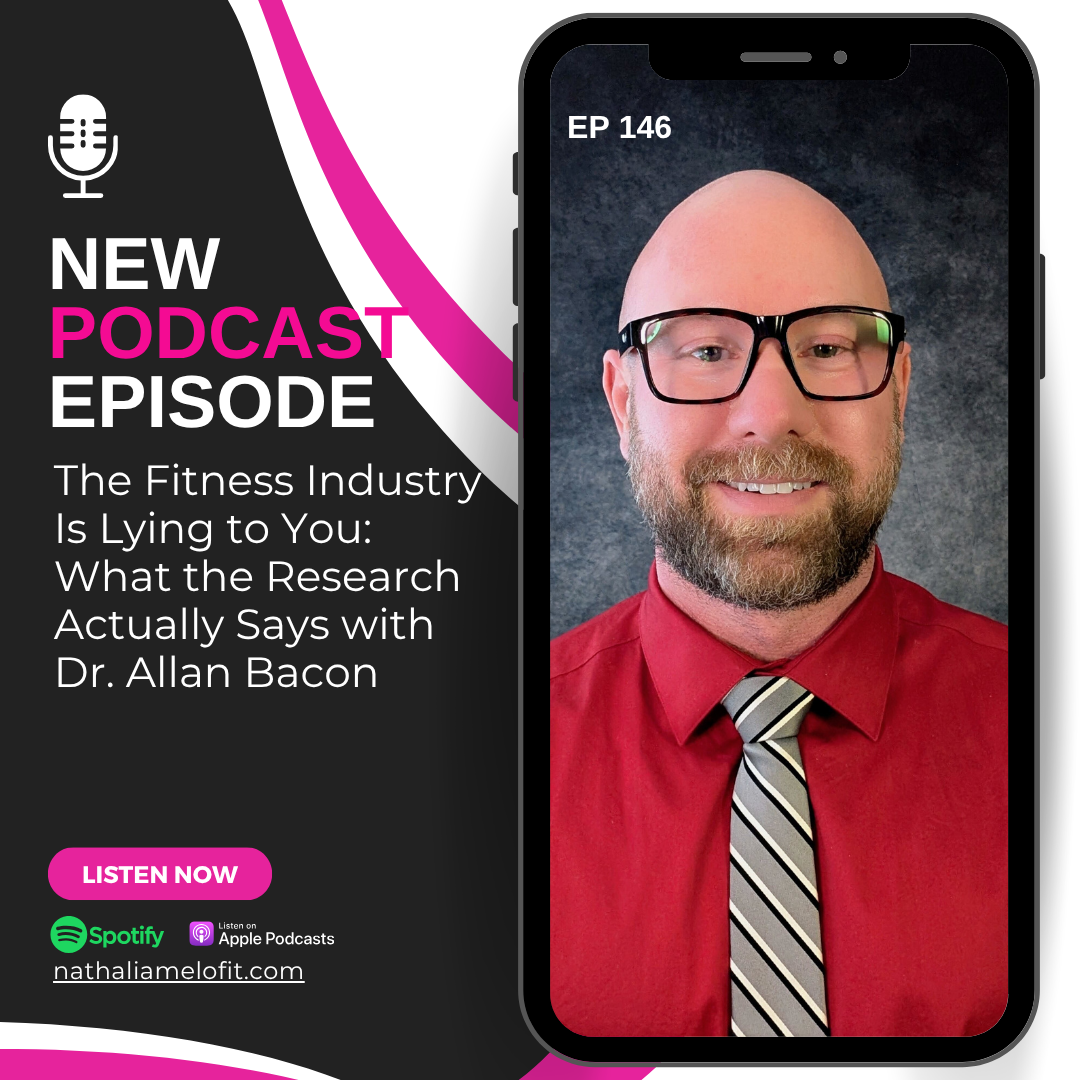
You have been told you have to eat before you train. You have been told women need a completely different approach. You have been told peptides are the missing piece. Most of it is wrong. And in this episode, Dr. Allan Bacon breaks down exactly why.
Dr. Allan is a doctor and evidence-based fitness coach who left his dental practice to bring research-backed information to the fitness space after watching the industry manipulate people with pseudoscience, influencer codes, and fake restrictions.
This conversation covers everything from fasted training myths to dangerous peptide trends to what actually drives long-term results. If you are tired of being sold on the next big thing, this one is for you.
In this episode, we talk about:
- Why there is no research supporting a different training or nutrition approach for women
- What fasted versus fed training actually does and does not do
- The biggest red flags that tell you an influencer is selling you something false
- Why peptides are drugs and not supplements and why that matters
- How placebo and nocebo effects are secretly running your fitness results
- Why aura rings and whoop straps may be working against you
- What three things people who keep weight off actually have in common
- Why the simplest answer in fitness is almost always the right one
This is not a conversation about secrets or shortcuts. It is a conversation about what actually works, why most of what you see on social media does not, and how to cut through the noise so you can stop spinning your wheels and start moving forward.
Ever wish you had a fit and straightforward BFF with over 15 years of experience to help you filter through all the information regarding fitness, nutrition, and life? That's exactly what you'll get when you listen to the Unfiltered Fit Life Podcast.
Join Former Bikini Olympia Champion, mom of 2, and fitness coach Nathalia Melo each week as she shares fitness, nutrition, and life tips to help busy working moms simplify their fitness journey so they can learn easy and simple strategies on how to lose weight and feel sexy AF.
After helping over 5000 busy working moms, Nathalia has found the blueprint to fitness, nutrition, and life success, which she will be sharing in this podcast: actionable tips that will help busy working moms be more present at work and at home.
This show is for you if you realize that nothing good comes from your comfort zone and are ready to challenge yourself to achieve great things. Follow Unfiltered Fit Life wherever you are listening to join us each week for a splash of sass, humor, and a whole lotta truth.
Podcast Transcript
The Fitness Industry Is Lying to You: What the Research Actually Says with Dr. Allan Bacon
INTRODUCTION
Nathalia welcomes Dr. Allan Bacon, a former dentist turned evidence-based fitness coach. Alan shares the personal story behind his transition - including a deathbed conversation with his father who had practiced dentistry for 35 years and a Christmas Eve emergency surgery that pushed him to reevaluate how he wanted to spend his career. He explains how his medical background drives his commitment to research-backed information over anecdote.
SCIENCE VERSUS ANECDOTE
Alan breaks down the two camps in the fitness industry - the science-based side and the anecdote side - and argues that both have blind spots. Personal experience is often unreliable because people succeed despite what they are doing, not because of it. The goal is not to pick a side but to use the best available data and know when personal experience can guide decisions within the gaps research has not yet filled.
THE FASTED VERSUS FED TRAINING MYTH
Alan addresses one of the biggest pieces of misinformation targeting women: the idea that you must eat before training or risk losing your progress and disrupting your hormones. The research on both men and women at every stage of life including menopause shows it simply does not matter. What matters is whether you feel better eating before training or not. The answer, as with almost everything in fitness, depends on the individual.
THERE IS NO SPECIAL PLAN FOR WOMEN
Alan makes a direct and research-backed argument: when you account for age and activity levels, men and women respond to training and nutrition in virtually identical ways. The idea that women need a completely different approach is a marketing tactic that steals informed consent by giving people false information. Adjustments are made for personal preferences, goals, and schedules - not for gender.
RED FLAGS IN FITNESS AUTHORITIES
Alan walks through how to identify untrustworthy voices in the fitness space. Key red flags include: branding an entire identity around one specific mechanism or diet, never updating their beliefs, selling products designed for hyper-specific demographics with false precision, and using complexity and big words to manufacture authority. The person keeping it simplest is usually the most honest. If anyone says mitochondria, Alan suggests you ignore them entirely.
PEPTIDES: DRUGS BEING SOLD AS SUPPLEMENTS
Alan names peptides as the biggest current piece of misinformation in the fitness and wellness world. Peptides are a class of drugs, not supplements, and things like BPC-157 are illegal to compound for human use in the United States. He shares serious concerns about online pharmacies and influencer codes driving people toward unvalidated substances with real potential for harm including cancer risk through angiogenesis. He is not anti-peptide but is firmly against the way they are being sold without appropriate medical oversight.
PLACEBO AND NOCEBO: THE HIDDEN FORCE IN YOUR RESULTS
Alan shares a striking study in which competitive powerlifters gained an average of 22 pounds across their lifts in one week after being told they were taking a fast-acting steroid - which was actually a placebo. The group told the truth immediately lost those gains. The group that still believed they were on the steroid kept every pound. He connects this directly to wearable technology and explains that when devices tell people their recovery is poor, performance actually drops as a result.
WEARABLES AND HRV
Alan explains that heart rate variability, the metric used by most popular wearables, has not been validated for predicting sleep quality, recovery from weight training, or calorie burn. The data that does exist for HRV applies primarily to endurance cardio. His advice: ask yourself how you feel and how you are performing. That is the only meaningful data point most people need - and a device telling you that you slept badly will make you perform worse even if you felt fine when you woke up.
WHAT PEOPLE WHO KEEP WEIGHT OFF ACTUALLY HAVE IN COMMON
Alan shares three research-backed traits common to people who lose excess body fat and keep it off: lower food variety meaning a rotating set of go-to meals rather than endless novelty, cooking for themselves and eating out rarely, and tending toward lower fat intake which naturally increases fruits and vegetables and improves satiety. Lower food variety prevents the buffet effect that drives cravings and makes meal prep and portion awareness far easier over time.
BUILDING IDENTITY AND CONSISTENCY
Alan and Nathalia discuss how real change is built not on motivation but on showing up even when you do not feel like it. Going to the gym for even 20 minutes when you are tired builds the identity of an athlete and that identity eventually takes the choice out of the equation entirely. He describes keeping a journal after vacations or slips to note what he would do differently next time and treating every stumble as a learning experience rather than a failure.
ACCEPTING RESPONSIBILITY
Alan makes the case that accepting your role in where you currently are is one of the most important cornerstones of real change. When people attribute everything to external factors they have nothing they can actually fix. Recognizing your own patterns gives you something to work with and frames every setback as a data point rather than a reason to quit.
CLOSING
Nathalia and Alan close by reflecting on how aligned their approaches are despite coming from very different backgrounds. Nathalia shares that her own experiences in competitive bodybuilding - including being told to wear three waist trainers at once and eating orange roughy until team members developed mercury poisoning - is what pushed her to do things differently. Alan can be found at MauiAthletics.com and on Instagram at dr.allanbacon.