You can feel happy with your life and still be quietly telling yourself a story about your health. Complacency has a way of sounding exactly like contentment, and most of the women I work with can't tell the two apart until someone asks them the right question.
In this episode of the Unfiltered Fit Life Podcast, Coach Jen and I sit down for another Unfiltered and Unscripted conversation about the mindset I hear most often before someone joins the Powerhouse Academy, and again once they start seeing results: "it's not that bad." We talk through what separates contentment from complacency, how to know which one you're in, and why the answer has less to do with how you feel and more to do with what you do next.
We also get into the cycle so many high-achieving women get caught in, where change only happens when you dislike what you see, and what happens the moment you finally feel good and don't know where to go from there. Along the way we talk about body positivity, the standards you hold for everyone else in your life, and the people you say you're doing this for.
In this episode, we talk about:
- The difference between contentment and complacency
- The "what came first" question that gives you your answer
- Why "it's not that bad" is a comparison to your worst day
- The hate-to-hustle cycle and why it stops working once you feel good
- Where "give yourself grace" crosses the line into gaslighting yourself
- The standards you hold at work and at home that you drop for your own body
- Why you can have a big goal and still enjoy where you are
- A simple weekly self-assessment you can use right away
If you listen and realize you've been grading yourself against your worst day, your timing is good. On October 27th I'm hosting a free 2-day live training, How to Lose Up To 18lbs of Fat By Christmas, Without Skipping the Holiday Parties, Dinners Out & Wine. It's built for women who want to keep moving forward without punishing themselves to do it. Save your free spot here.
Ever wish you had a fit and straightforward BFF with over 15 years of experience to help you filter through all the information regarding fitness, nutrition, and life? That's exactly what you'll get when you listen to the Unfiltered Fit Life Podcast.
Join Former Bikini Olympia Champion, mom of 2, and fitness coach Nathalia Melo each week as she shares fitness, nutrition, and life tips to help busy working moms simplify their fitness journey so they can learn easy and simple strategies on how to lose weight and feel sexy AF.
After helping over 5000 busy working moms, Nathalia has found the blueprint to fitness, nutrition, and life success, which she will be sharing in this podcast: actionable tips that will help busy working moms be more present at work and at home.
This show is for you if you realize that nothing good comes from your comfort zone and are ready to challenge yourself to achieve great things. Follow Unfiltered Fit Life wherever you are listening to join us each week for a splash of sass, humor, and a whole lotta truth.
Podcast Transcript
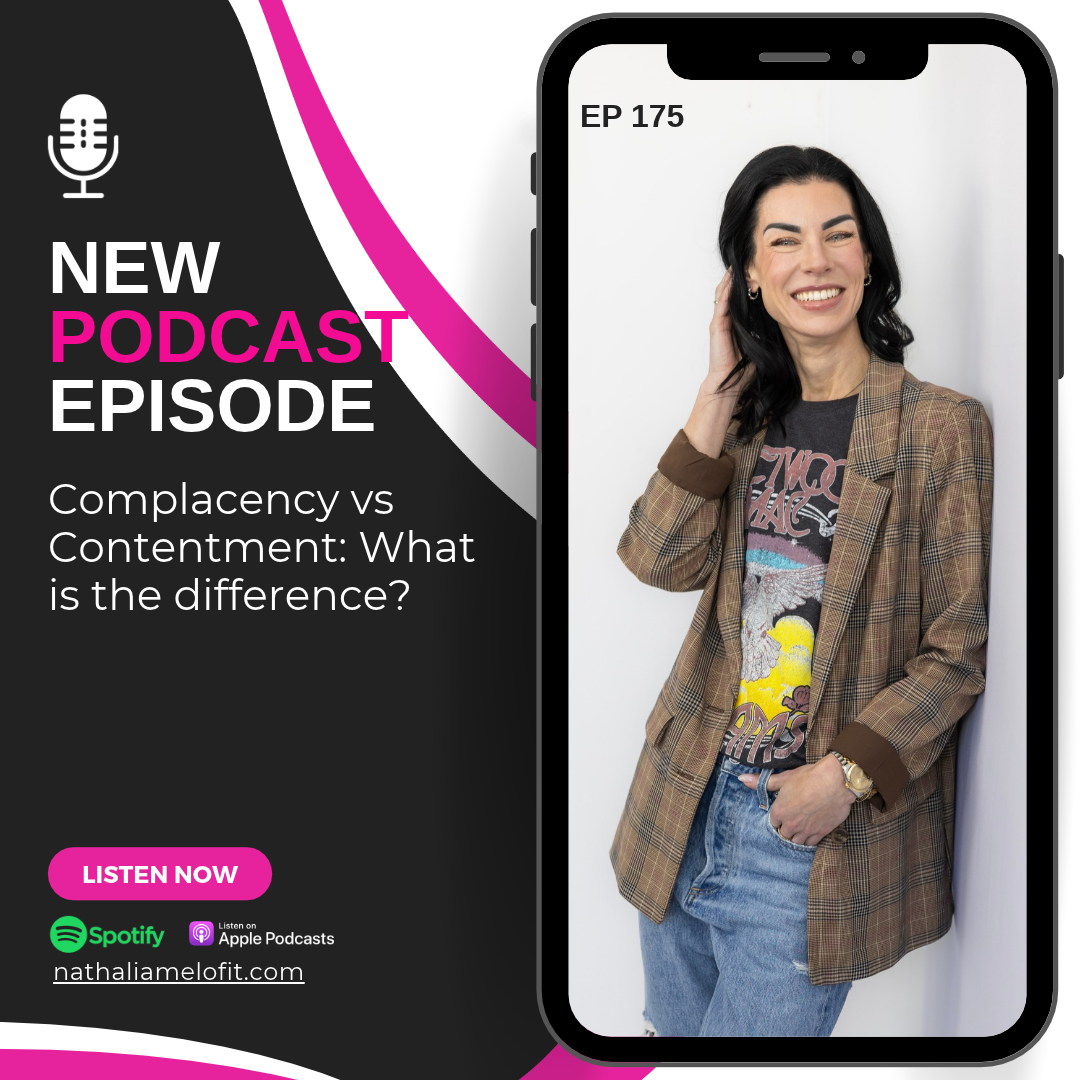
Complacency vs Contentment: What is the difference?
WHERE “IT'S NOT THAT BAD” COMES FROM
Coach Jen and I open with a mindset I see before women ever join the Powerhouse Academy and again once they start making progress: the quiet decision that this is probably where they are supposed to be. I explain how people talk themselves into feeling content while deep down they know they have stopped showing up, and why advice from people who don't live the lifestyle you want rarely moves you forward.
CONTENTMENT VS. COMPLACENCY
Jen lays out the difference. Contentment means you are satisfied with your life and still open to growth, while complacency means you are resisting growth and calling it peace. I share the way I put it for myself: contentment is being happy and still showing up, and complacency is a justification for skipping the thing you told yourself you would do.
THE “WHAT CAME FIRST” QUESTION
I give you the first self-check I use: what came first, the slip or the feeling of pride? If you messed up and then started telling yourself it's fine, that points one direction. If you felt great about your progress and still want to build on it, that points another. Jen adds that your brain will happily hand you a rationalization whenever you ask for one.
WHY WOMEN CHANGE OUT OF HATE
I talk about phase three of the Powerhouse Academy, where I see complacency show up most, and the pattern behind it. Many women are used to using hurt and frustration as fuel, so when they finally feel good they have no idea how to keep moving. Jen describes it as reacting instead of responding, and punishing yourself into progress instead of enjoying the process.
COMPARING YOURSELF TO YOUR BEST VERSION
I share why I push back on “comparison is the thief of joy.” If you are going to compare, I would rather you compare yourself to the best version of you than the worst one. Jen brings in the question of what you would say to your kids if they brought home “it's not that bad” as a grade, and why we skip that standard for ourselves.
THE STANDARDS YOU KEEP EVERYWHERE ELSE
We talk about how high-achieving women would never accept “not that bad” from a team member, a child, or a spouse, yet they accept it for the body that carries them through every other area of life. Jen asks where we learned that “just enough” is okay in this one area.
BODY POSITIVITY AND IGNORING HOW YOU FEEL
I say something I expect some people to disagree with. The way body positivity is often presented can turn into gaslighting, because women quietly know they don't feel good and are told to move on. Jen connects it to autonomy and toxic positivity, and we both ask why we accept a message that goes against our own honest read of ourselves.
OUTSOURCING HOW WE FEEL
I talk about how we hand our feelings, our worth, and even our sense of whether we slept well to devices and ideologies. Jen explains why discomfort passes itself off as comfort, and I make the case for being honest about the numbers when your health is on the line.
THE PEOPLE WHO FEEL IT WHEN YOU STAY STUCK
This is the heavy part of the conversation. Jen and I talk about how complacency affects your kids, your partner, and the people you lead, and share the personal reasons this hits close to home for both of us. I contrast that with my mother-in-law, who is in her seventies and still sprinting through obstacle courses and skiing with the family.
MAINTENANCE COUNTS
Jen reframes the goal for anyone who feels overwhelmed by improvement. You maintain your house and your car, so your body deserves the same, as long as you are maintaining a healthy place and not an unhealthy one. I add that contentment and ambition can live together because you love something enough to keep building it.
THE HATE-TO-HUSTLE CYCLE
I connect complacency and self-sabotage, using bodybuilding competition cycles as an example. When your only tool for reaching a goal is dislike of what you see, you reach the top of the mountain, lose your fuel, and slide back so you can start again. Jen describes growth as a constant trend line upward instead of a finish line, and I explain that the real challenge is becoming the person who can sustain the result.
FOOD MORALITY AND EARNING YOUR MEAL
We talk about “good” and “bad” food, “earning” Thanksgiving dinner, and the idea that transformation has to be rooted in pain. I share my own shift from bingeing in secret to stopping because I felt proud of my progress, and both of us explain how both things can be true: you can work hard because you love your body and still enjoy the meal with your family.
SAYING YES AND NO ON PURPOSE
I describe the difference between women who say no because they are uncomfortable with how they look and women who say no because a choice doesn't line up with who they want to become. Jen talks about outgrowing old seasons, old routines, and sometimes old relationships, and why accepting that growth took her a while.
FEELS GOOD VS. ALIGNED
Jen shares that she no longer sees her choices as sacrifices, and I push back on using “feels good” as the guide, since in the moment skipping a workout can feel good too. We land on a clearer way to describe it: sleeping well, waking up with energy, and asking whether a choice is aligned with where you want to go.
THE SELF-ASSESSMENT QUESTIONS
I walk through the questions you can ask yourself: what did I say I wanted when I started, what came first, and if I had an amazing week, would I still say this is where I want to be? Jen shares the definitions she wrote out and adds a weekly check-in about the one step, or the one percent, you can do better.
BIG HAIRY GOALS AND SMALL STEPS
I explain why I like big, hairy goals and why it helps to put them in your back pocket and work backward from them. Jen adds that everything starts with an initial step, and we talk about why you can't let a goal that is years away give you permission to procrastinate today.
FAILURE AND SUPPORT
Both of us admit we have already failed at something by noon on most days. The question I ask is whether you have the support to get back up, because the failure itself was never the problem.
FINAL THOUGHT
Jen leaves you with this: don't punish yourself into submission to change. I close with my favorite line from the conversation, respect yourself enough to change, and yes, it might end up on a t-shirt.

Free 2-Day Live Training
How to Lose Up To 18lbs of Fat By Christmas, Without Skipping the Holiday Parties, Dinners Out & Wine. Starts October 27th.