A professional dancer brought her two-year-old on stage during her own presentation because the toddler threw a tantrum and she could not say no. People celebrated it on social media. And I could not stop thinking about how many women are living that same pattern every single day - just in quieter, less visible ways.
In this Unfiltered and Unscripted episode Coach Jen and I are having the boundaries conversation nobody actually has. Not the version that ends with blame the patriarchy. Not the version that ends with just say no. The version that starts with why this is happening, what it is costing you, and what to actually do about it.
This one is going to make some of you uncomfortable. That is kind of the point.
In this episode, we talk about:
- Why people pleasing is a confidence problem first and a boundaries problem second
- What the real definition of a boundary is and why it keeps getting overcomplicated
- What resentment inside a family actually looks like and why women will not name it
- Why saying not right now is not choosing work over your kids
- How boundaries filter out the people who only benefited from your lack of them
- Practical scripts for the hardest scenarios - the sister, the mid-call mom moment, the I'm sorry habit, and the spouse conversation
- Why a problem deferred is a problem amplified
- What age kids actually start understanding no - and why it is younger than you think
Blaming culture or conditioning without addressing what to do next removes your own agency. This episode is about getting it back.
Ever wish you had a fit and straightforward BFF with over 15 years of experience to help you filter through all the information regarding fitness, nutrition, and life? That's exactly what you'll get when you listen to the Unfiltered Fit Life Podcast.
Join Former Bikini Olympia Champion, mom of 2, and fitness coach Nathalia Melo each week as she shares fitness, nutrition, and life tips to help busy working moms simplify their fitness journey so they can learn easy and simple strategies on how to lose weight and feel sexy AF.
After helping over 5000 busy working moms, Nathalia has found the blueprint to fitness, nutrition, and life success, which she will be sharing in this podcast: actionable tips that will help busy working moms be more present at work and at home.
This show is for you if you realize that nothing good comes from your comfort zone and are ready to challenge yourself to achieve great things. Follow Unfiltered Fit Life wherever you are listening to join us each week for a splash of sass, humor, and a whole lotta truth.
Podcast Transcript
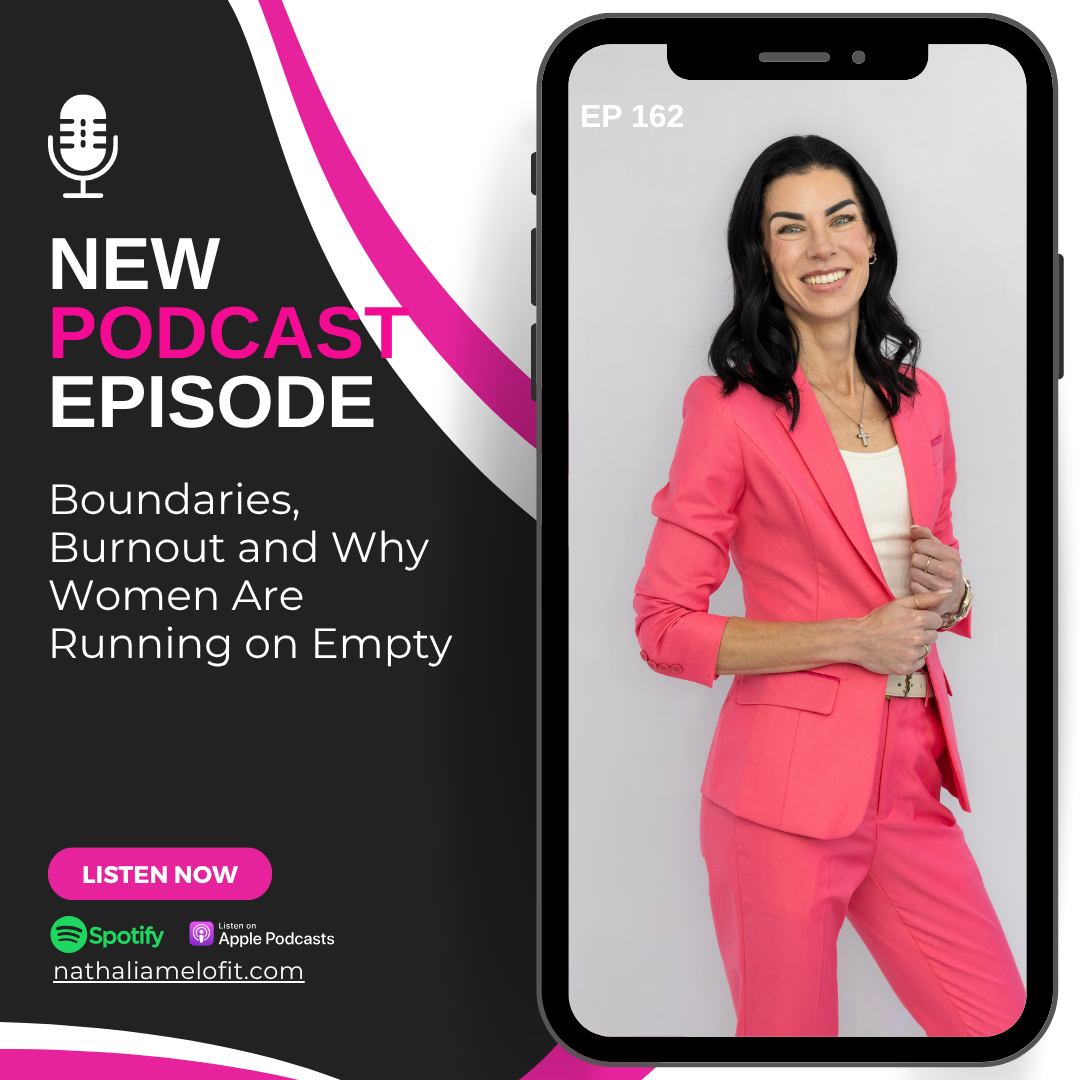
Boundaries, Burnout, and Why Women Are Running on Empty
INTRODUCTION
Nathalia and Coach Jen open with a reference to a viral video of a professional dancer who brought her two-year-old daughter on stage during her own presentation because the child threw a tantrum and would not let her go. The caption framed it as sweet. Nathalia frames it as a symbol of a much bigger pattern - the romanticization of having no boundaries - and uses it to set up the episode's core argument that this kind of conditioning is one of the primary reasons women are burned out.
WHAT BOUNDARIES ACTUALLY DO FOR CONFIDENCE
Jen makes the connection that most women come to the Powerhouse Academy wanting to build confidence - but what they do not realize is that boundaries are what create confidence in the first place. People pleasing is a confidence problem. It is a behavior pattern driven by the need for external approval. When you set boundaries consistently, confidence becomes the byproduct. The two are inseparable and most women have never been taught to connect them.
THE CONDITIONING IS REAL - AND SO IS YOUR AGENCY
Nathalia shares data showing that social conditioning toward people pleasing begins as early as preschool for girls. She uses the example of her own mother-in-law apologizing repeatedly for eating slowly - behavior her daughter Chloe even picked up on. The conditioning is real and culturally embedded, particularly in Latino and Asian cultures. But blaming culture or the patriarchy without addressing what to do next removes your own agency. Both are true - the conditioning exists and you can still choose differently.
WHAT LACKING BOUNDARIES ACTUALLY LOOKS LIKE
Nathalia walks through the specific patterns she sees constantly - hosting every holiday because it is just easier if she does it, attending every birthday party every weekend because she cannot say no to her kids, answering mom mom mom mid-work call because saying not right now feels like choosing work over her children, signing kids up for every activity at the cost of her own sanity, and apologizing before disagreeing in meetings. These are not personality quirks. They are the behavioral fingerprint of someone who has no clear limits for what she is and is not available for.
RESENTMENT IS REAL AND WOMEN WILL NOT NAME IT
Nathalia shares that she has had calls where women describe frustration toward their family in unmistakable terms - and when she names it as resentment they immediately push back. So she flips the script - she describes the exact same behavior but replaces the kids with a friend. And suddenly yes, that does sound like resentment. Jen adds that children are humans, and you can feel resentment toward humans. What matters is accepting responsibility and understanding that the resentment is a signal that something needs to change, not a character flaw.
FINANCIAL BOUNDARIES AND THE WOMAN WHO COULD NOT JUSTIFY IT
Nathalia shares the story of a woman who spent 45 minutes describing how miserable she was - her mood dragging down the whole household, her husband noticing, the family trips she could not enjoy. This same woman had her kids in travel cheer, travel soccer, and private school. And when Nathalia brought up the program she said she could not justify spending that on herself. The point is not judgment. The point is that she was already doing it - the cost of not investing in herself was already being paid by her entire family every single day.
BOUNDARIES AS A FILTER
Nathalia shares that when she started competing, two camps emerged. One camp was people who did not respect her new boundaries because her taking care of herself became an uncomfortable mirror for what they were not doing. The other camp was people who were only there when she was available to party. Setting boundaries made both groups self-select out. Jen adds her own story of ending a friendship where she was being used as an alibi. The takeaway is that the people who leave when you start setting limits were never really there for you - they were there for your availability.
PRACTICAL SCRIPTS FOR THE HARD SCENARIOS
Nathalia runs Jen through four real scenarios. The sister who asks you to babysit for the fourth weekend in a row - Jen's approach is to ask questions and get clarity on what is actually happening before responding. The mid-work-call mom moment - both Nathalia and Jen agree on a firm not right now, mama is busy, I will come find you when I am done. The I'm sorry habit before every disagreement - Jen encourages pausing, removing the apology, and recognizing that saying sorry before speaking is telling yourself you are not worth being heard. The spouse conversation - Jen recommends a dedicated weekly walk-and-talk to address what is working and what is not before it becomes resentment.
WHAT AGE TO START WITH KIDS
Nathalia asks at what age it is appropriate to start setting limits with kids. Jen says children begin understanding the undertone of no as soon as they develop verbal skills - around age two. True comprehension comes around six or seven. But the earlier you start the stronger the behavioral patterns become. Studies show that clear rules and regulations actually reduce anxiety in children, not increase it. Children who grow up with consistent limits feel more secure, not more rejected.
CLOSING
Nathalia and Jen close by inviting listeners to send in questions via fan mail for the next episode since this topic will likely trigger a lot of follow-up thoughts. The final message from both is that this is not about blaming anyone - it is about reclaiming your agency in the one life you have.